

Most mower batteries fail to charge due to bad connections, sulfation, or a faulty charger.
If your lawn mower battery will not charge, you are not alone. I’ve spent years fixing dead batteries and weak charging systems in both walk-behind and riding mowers. In this guide, I will explain why a lawn mower battery will not charge, how to diagnose it fast, and what to do to fix it the right way.
Symptoms and quick checks when a lawn mower battery will not charge
When a lawn mower battery will not charge, you can spot repeat signs. These quick checks save time.
Common symptoms:
- The engine cranks slow or clicks only.
- The headlight is dim or flickers at idle.
- The battery shows a charge after the charger, then drops fast.
- The battery is warm or smells like sulfur after charging.
- The voltmeter never rises above 12.6 V with the engine running.
Fast checks you can do now:
- Look for loose or corroded terminals. Clean and tighten them.
- Inspect the fuse and charging wires near the engine shroud.
- Test resting voltage. A healthy 12 V battery should read about 12.6 to 12.8 V.
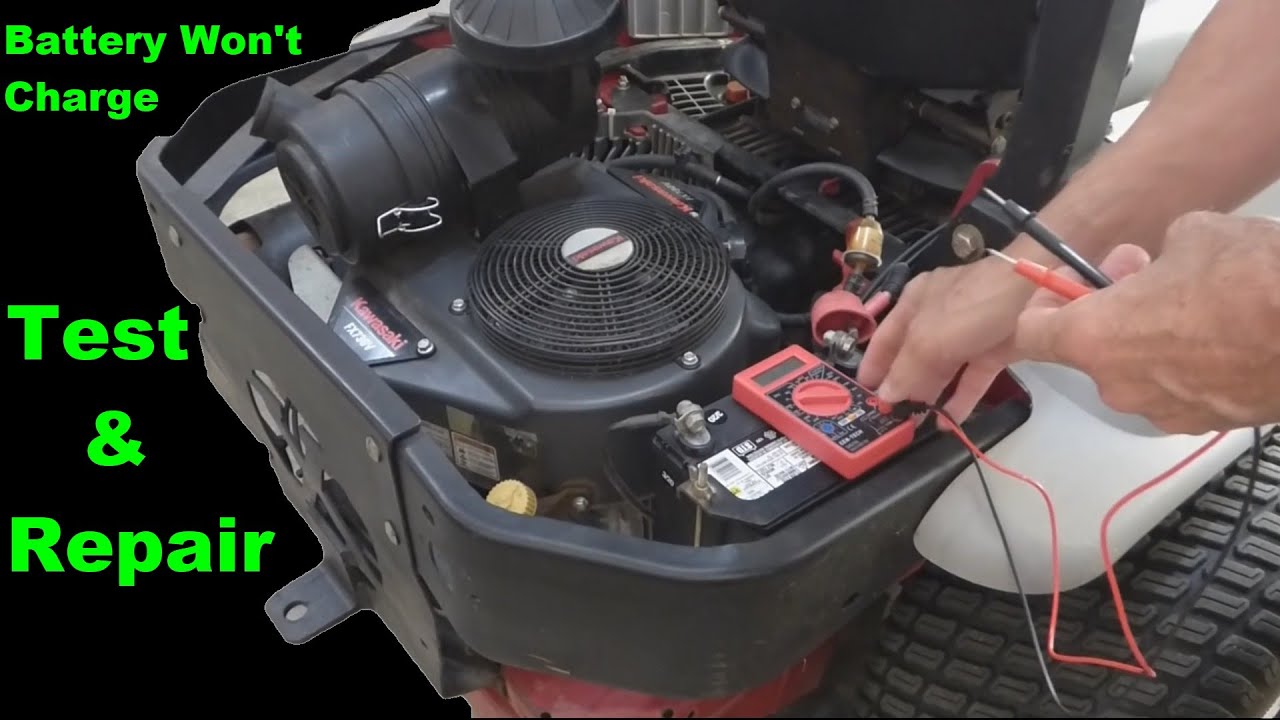
- Start the engine and rev slightly. A working system should show about 13.8 to 14.5 V at the battery.
If these basics fail, it points to why a lawn mower battery will not charge: the battery cannot take a charge, the charger is weak, or the mower’s alternator setup has an issue.

How the charging system works on most mowers
To fix the problem right, it helps to know how the system works. Most riding mowers use a small alternator under the flywheel. It is a stator with magnets on the flywheel. AC power from the stator goes to a voltage regulator or rectifier. The regulator turns AC to DC and holds it near 14 V. That DC feeds the 12 V battery.
On many walk-behind mowers with electric start, there is a small coil. It gives low current and only tops off the battery. Some have no charge coil at all. That is why a lawn mower battery will not charge if it is run down far on these small units.
Key parts:
- Battery: 12 V lead-acid or lithium-ion, often size U1 or U1R.
- Stator: makes AC power as the engine spins.
- Regulator or rectifier: makes DC and limits voltage.
- Wiring, fuse, and switch: deliver power and protect the circuit.
If any link fails, a lawn mower battery will not charge even if the engine runs fine.

Common reasons a lawn mower battery will not charge
From shop experience, these are the top causes when a lawn mower battery will not charge.
Battery related:
- Sulfation from sitting. Plates harden and refuse to take a charge.
- Low electrolyte in serviceable lead-acid cells.
- Internal short or open cell after deep discharge or vibration.
- Wrong battery type or capacity for the mower.
Charging system faults:
- Burned stator or broken wire under the flywheel.
- Failed regulator or rectifier. Output stays low or spikes.
- Blown fuse, loose ground, or corroded connectors.
Charger and usage issues:
- Using a weak trickle charger on a deeply discharged battery.
- Charger not matched to lithium or AGM chemistry.
- Parasitic drain from accessories or a faulty module.
Environment and storage:
- Long off-season storage without a maintainer.
- Heat and vibration that loosen posts and lugs.
- Moisture that wicks into connectors.
When any of these hit, a lawn mower battery will not charge well, or not at all.

Step-by-step troubleshooting when a lawn mower battery will not charge
You can diagnose most cases with a simple multimeter. Follow this order.
Safety first:
- Wear eye protection and gloves.
- Work in a ventilated space.
- Remove jewelry. Avoid sparks near batteries.
Tools:
- Digital multimeter.
- Smart charger with recondition mode if possible.
- Wire brush, baking soda, and water for cleaning.
Steps:
- Inspect and clean
- Check posts, clamps, and ground straps. Clean white or green crust. Tighten all lugs. Many times, a lawn mower battery will not charge due to a loose ground.
- Measure resting voltage
- After the battery sits 30 minutes, read volts.
- About 12.6 to 12.8 V is full.
- About 12.2 V is half.
- Under 12.0 V is very low and may be sulfated.
- Try a charge test
- Connect a smart charger. Note start current and voltage rise.
- If current falls fast and voltage jumps high but capacity stays poor, plates may be sulfated.
- If the charger shows error or no acceptance, the battery may be open or shorted.
- Check charge voltage with engine running
- Start the engine. Bring RPM a bit above idle.
- A healthy system shows about 13.8 to 14.5 V at the battery.
- If it stays near the same as resting voltage, the stator or regulator may have failed.
- Test the stator AC (riding mowers)
- Unplug the stator lead to the regulator.
- Measure AC between the two stator wires at fast idle.
- You should see tens of volts AC. If AC is near zero, the stator is bad.
- Test the regulator output
- With stator connected and engine running, measure DC at the regulator output.
- If the stator AC was good but DC is low, the regulator is bad.
- Check fuses and ignition switch feed
- Pull the fuse near the battery. Test and replace if weak.
- Wiggle test the harness while watching voltage for drops.
- Look for parasitic drain
- With the key off, set the meter to measure current in series with the battery.
- Draw should be near zero on most mowers. A steady draw can drain a good battery over days.
- Make the call
- If one cell gasses hot or voltage rebounds fast but falls under load, replace the battery.
- If AC is good but DC is not, replace the regulator.
- If AC is dead, replace the stator.
Follow this path, and you will know why your lawn mower battery will not charge and how to fix it with confidence.
Battery types and what they need to charge right
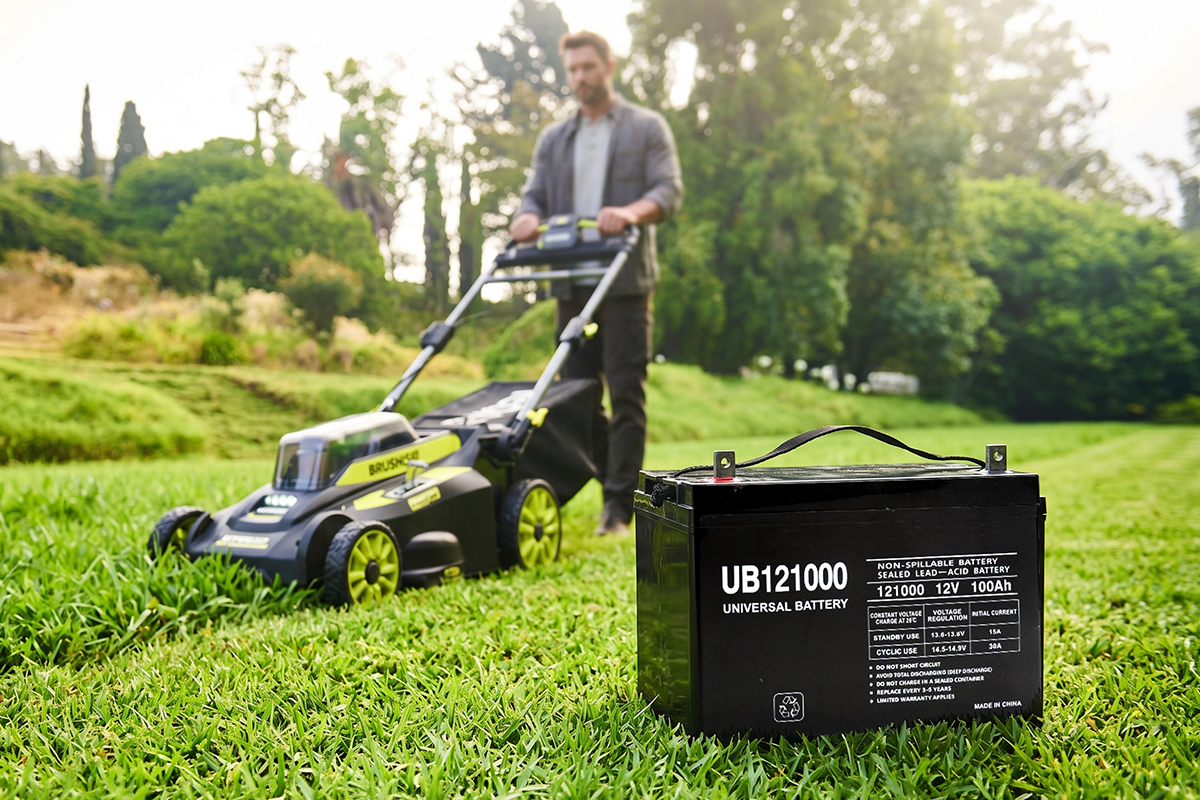
Not all mower batteries behave the same. If the wrong method is used, a lawn mower battery will not charge or may get damaged.
Lead-acid flooded (most common):
- Needs 14.2 to 14.6 V bulk charge.
- Electrolyte should cover the plates. Top off with distilled water if serviceable.
- Hates sitting below 12.4 V. Use a maintainer in storage.
AGM lead-acid:
- Lower internal resistance. Charges faster.
- Needs a smart charger with AGM mode to avoid over-voltage.
Lithium iron phosphate (LiFePO4) with BMS:
- Light and strong cranking.
- Must use a charger and regulator approved for lithium.
- The BMS may block charging below freezing or if voltage is too low.
If you mix the wrong charger with the battery type, the lawn mower battery will not charge well, and life will be short.

Charger selection and how to test it
A charger can cause the issue too. I have seen many cases where a lawn mower battery will not charge, and the charger is the real fault.
Choose the right charger:
- Use a smart charger with automatic bulk, absorb, and float.
- Pick 2 to 4 A for U1 size batteries to avoid heat.
- Match the mode to flooded, AGM, or lithium.
Test the charger fast:
- Measure output with no battery. Many smart chargers need a battery to start, so this may read zero.
- Connect to a known good battery. Watch current and voltage climb.
- If current never rises or the unit trips at once, the charger is weak.
- If voltage climbs over 15 V on lead-acid, the charger is overcharging.
A poor charger means the lawn mower battery will not charge even if the battery is fine.
Preventive care so a lawn mower battery will not charge problems do not return
Most failures are preventable. Simple habits pay off.
Easy habits:
- Put the battery on a maintainer when stored.
- Keep terminals clean and tight. Use dielectric grease on clean metal.
- Inspect the charging wire and regulator bolts each oil change.
- Secure the battery hold-down to limit vibration.
- Store the battery cool and dry. Avoid concrete floors without a tray.
Testing schedule:
- Check resting voltage monthly in the off-season.
- Load test at the start of mowing season.
- Verify charge voltage once a year.
With these steps, the chance that your lawn mower battery will not charge again drops a lot.
When to replace the battery and how to choose one
Sometimes the right fix is a new battery. Signs are clear.
Replace when:
- Resting voltage falls below 12.0 V after a full charge.
- It cannot hold above 9.6 V during a 10-second crank.
- It needs frequent boosts and shows one hot cell.
- It is past 3 to 5 years old and weak.
How to choose:
- Match group size (often U1 or U1R) and terminal layout.
- Pick the right chemistry for your charging system.
- Check cold cranking amps that meet or exceed spec.
- Buy from a source that tests and rotates stock.
If you skip these checks, the new lawn mower battery will not charge well or may fail early.

Safety notes, mistakes to avoid, and real-world tips
Over the years, I have seen simple errors turn into big costs. Learn from these wins and misses.
Mistakes to avoid:
- Jump-starting with a running car. Spikes can fry the regulator.
- Swapping battery cables backward. This can blow the fuse and regulator fast.
- Charging a frozen battery. It can crack or vent.
Field tips that help:
- If the mower sat all winter and the lawn mower battery will not charge, try a smart charger with a recovery mode. It can break mild sulfation.
- If you find black goo under the flywheel, the stator may have overheated. Replace it with the regulator as a pair.
- If voltage is good at idle but drops with lights on, check for a loose ground from frame to engine.
These small checks save time and money when a lawn mower battery will not charge.
Frequently Asked Questions of lawn mower battery will not charge
Why does my lawn mower battery will not charge even with a new battery?
A bad regulator, a blown fuse, or a broken stator can block charge. Test charge voltage with the engine running and trace power from the stator to the battery.
Can a bad solenoid make the lawn mower battery will not charge?
A bad solenoid stops cranking but does not control charging. Charging faults come from the stator, regulator, wiring, or the battery itself.
How long should I charge a dead mower battery?
Use a 2 to 4 A smart charger for 6 to 12 hours, then test. If it still drops under load, the battery is likely sulfated or worn out.
Is it safe to use a car charger if my lawn mower battery will not charge?
Yes, if it has a low-amp mode and the right chemistry setting. Avoid high-amp boost and stop if the battery gets hot or vents.
What voltage should I see if the charging system works?
Around 13.8 to 14.5 V at the battery with the engine above idle. Below 13.2 V means undercharge; above 15 V risks damage.
Why does my battery die after a week of sitting?
A small parasitic draw or a weak battery can drain it. Measure key-off current and keep a maintainer on during downtime.
Will a lithium replacement fix when a lawn mower battery will not charge?
It can help if weight and cranking are issues, but only if the regulator and charger are lithium-safe. If not, you may see charge cutoffs or damage.
Conclusion
When a lawn mower battery will not charge, the fix is usually simple if you test in the right order. Check the connections, confirm battery health, verify charge voltage, and then rule out the stator and regulator. Match the charger and battery type, and keep a maintainer on during storage.
Take action today. Do the five-minute tests, make one change at a time, and note results. If you found this useful, subscribe for more small engine fixes, or drop a question in the comments so we can solve it together.